
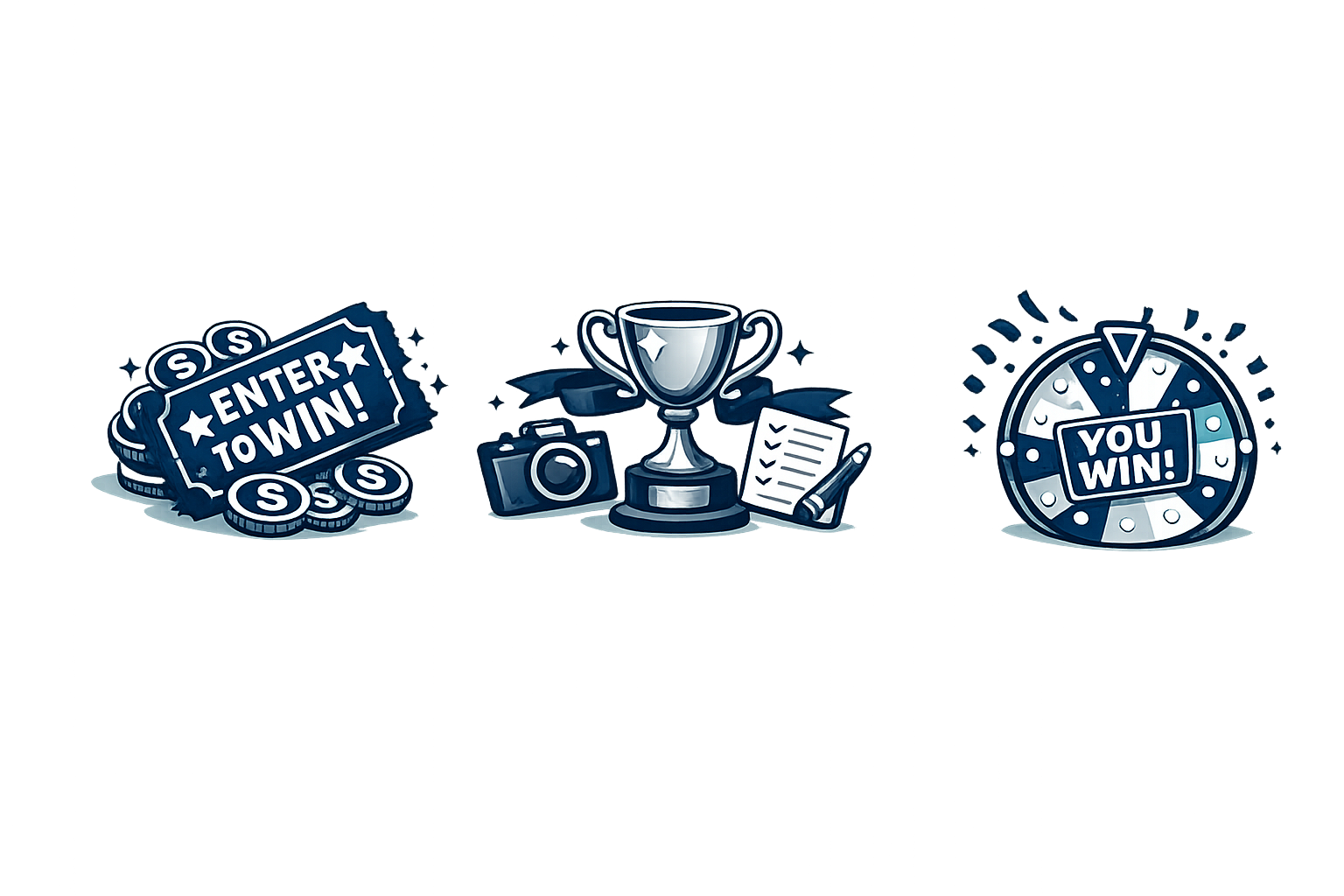
Marketers throw these terms around like they mean the same thing. And we get it, sometimes the terms are interchangeable and meant to focus on programs that get consumers to take action, win something, and otherwise draw attention to the brand or service. But from our years of experience (trust us, it’s kind of our thing…), each mechanic is truly set up to drive a different behavior, can carry different legal considerations, and deliver a different business outcome. We know from experience that choosing the wrong structure can slow participation, create compliance headaches, or simply fail to move sales.
All that is good to hear, but then the question seems to come up: how do we choose the right promotion tactic, and more importantly, know it’s the right one for our goals? It’s not always that easy, and here are a few steps you can follow to help decide which may be correct.
First, Know the Legal Backbone
Yes, we often call this the least glamorous part. Like every foundation, it’s the most important to get right.
Most promotional programs revolve around three elements:
- Prize. Something you are giving away that has value.
- Chance. The randomness or odds of winning.
- Consideration. Usually, a payment or some level of effort is required to participate.
A legal promotion can include only two of these three elements. If all three show up together, you are entering lottery territory. In the United States and many other countries, only governments can legally run lotteries.
If you want a deeper legal overview, the Federal Trade Commission provides guidance on promotional marketing and disclosures here:
https://www.ftc.gov/business-guidance/advertising-marketing
This legal framework is what separates sweepstakes, contests, and instant win programs. Once you understand that, the strategic differences become much clearer. But here’s the thing, you need to make sure you clearly state the entry method and description in the rules so consumers are not confused.
Sweepstakes: Built for Reach and Simplicity
A sweepstakes is based on chance. Winners are selected randomly and participants do not influence the outcome through skill. Consumers like these for the random chance to win something great and if they participate, they know skill is not required.
Because of that structure, sweepstakes are designed to remove friction from the consumer entry process. They are typically easy to enter, they scale quickly, and are excellent ways to gather user information for future marketing purposes. At SDP, when we hear a client wants to grow their marketing list or generally increase awareness of their brand or product, sweepstakes are a tried and tested way to do this. Get the prizing right, make the entry process easy, and make sure you’re transparent with consumer data, and you’ll be on the right track for a successful program.
For the quick bullets, use a sweepstakes when you want to:
- Grow an email or CRM database
- Drive mass participation
- Support a product launch or seasonal push
- Layer a promotion onto packaging or retail activation
You are trading depth for scale. And that is usually the right move when the goal is visibility. You can also hone in on a specific goal listed above, but generally, sweepstakes will help you reach a few key performance indicators (ah yes, the KPIs…) for the program.
There are so many examples out there, and one we like right now is the Driscoll’s Berry Birthday program: https://www.driscolls.com/rewards-birthday.
Contests: Built for Engagement and Brand Storytelling
A contest is a promotion based on skill. Winners will enter and complete some sort of task, like providing photos, videos, recipes, or essays. They are chosen through judging criteria such as creativity, knowledge, or performance.
Contests are a fantastic way to inspire and gather user generated content (UGC). When you think about a contest, we usually consider that the content we enter can be used across different media channels, and it often gets consumers thinking more deeply about the brand and why it has an impact in their life. This immediately changes participant behavior. That effort leads to stronger engagement and often better brand connection.
Contests are ideal when you want to:
- Generate user-created content
- Highlight creativity or product usage
- Build community around a brand
- Tell a story instead of just offering a prize
We always tell our clients that, when you run a contest, you are focusing on Quality vs. Quantity. More effort is usually required from consumers to enter the contest, and as such, you may not see as many entries as you would in a sweepstakes. But don’t you worry, when you get amazing submissions and have to agonize over which is the best, it’s a good problem to have.
Use contests when you want to highlight a new aspect of the brand, or feel your existing consumers can help show others why they love your brand or product. We’ve even seen brands get aggressive with their contest, like having fantasy football owners describe their league punishment and why their loser deserves to have the brand provide the ultimate fantasy football punishment.
Instant Win: Built for Immediate Action and Repeat Visits
Instant win programs tell participants right away whether they have won. That immediate response drives powerful consumer behavior when set up correctly, and is a great way to encourage your consumers to come back more often.
This taps directly into behavioral psychology. People respond to immediacy. A quick reward encourages repeat interaction and keeps momentum going throughout the campaign.
Instant win works well when you want to:
- Drive repeat purchases or visits
- Create urgency during a limited window
- Support loyalty or retention programs
- Turn passive audiences into active participants
Many retail and restaurant brands use instant win mechanics to influence frequency. That could be a digital spin-to-win, receipt upload reward, or surprise-and-delight moment. Overall, these do not have to live only online, and some of the best programs are on physical products or take a more hybrid approach and combine digital and physical aspects together for a more well rounded consumer experience.
Start With the Business Goal, Not the Tactic
This is where many teams go sideways, or put themselves down the wrong path. They pick a promotion format first and try to force it to solve the problem. Many teams assume these tactics are interchangeable. They are not. One may work, another may work better, and choosing correctly upfront saves time, budget, and frustration.
With that in mind, we always like to ask what behavior you want to change.
- Need awareness? A sweepstakes removes barriers and brings in volume.
- Need advocacy or storytelling? A contest creates investment.
- Need faster sales or repeat visits? Instant win drives urgency.
Every brand has its own context, but the decision framework stays the same. And even then, the general idea always needs to fit the brand and marketing mix already in place. The format is simply the vehicle. The objective should always drive the decision.
Many Successful Programs Combine These Approaches
You do not have to live inside one box. Some of the strongest campaigns layer mechanics together. For example:
- Instant win rewards to create daily excitement
- A sweepstakes entry tied to those interactions for a larger prize
- Optional engagement actions to deepen the experience
This blended model keeps participation high while still delivering moments that feel personal and fun. This, by far, is one of our favorite approaches. I mean, why limit your consumers to only one tactic when you can create a really cool experience with a few different tactics? But remember, the more you add on, the more clarity you will need, and you’ll need airtight rules and security.
A Practical Way to Decide Internally
Before locking in your promotion type, test it with three simple questions:
- What action do we want the consumer to take?
- How much effort are we asking from them?
- What outcome does the business actually need?
If those answers align with the structure you chose, you are on the right path.
If they do not, the promotion will struggle no matter how good the creative looks.
Promotions are powerful when they are built with intention. Sweepstakes, contests, and instant win programs are not interchangeable tactics, but can be combined for an exceptional consumer experience. When you match the right tool to the right objective, tailored for your brand, the results tend to follow.
Leave a Reply